Cart (0 Items)
Your cart is currently empty.
View Products



| Size | 100ug, 10mg, 1MG, 25mg |
|---|---|
| Isotype | IgG1, kappa |
| Brand | ProteoGenix |
| Product type | Primary Antibodies |
| Clonality | Monoclonal Antibody |
| Expression system | Mammalian cells |
| Applications | Elisa, WB |
| Product name | Benralizumab Biosimilar - Anti-IL5RA, CD125 mAb - Research Grade |
|---|---|
| Source | CAS 1044511-01-4 |
| Species | Humanized |
| Purity | >85% |
| Buffer | PBS buffer PH7.5 |
| Delivery condition | Blue ice (+4°C) |
| Delivery lead time in business days | 3-5 days if in stock; 3-5 weeks if production needed |
| Delivery Time | 3-5 days if in stock; 3-5 weeks if production needed |
| Storage condition | store at -80°C |
| Brand | ProteoGenix |
| Aliases /Synonyms | Benralizumab,BIW-8405,KHK4563,MEDI-563,IL5RA, CD125,anti-IL5RA, CD125 |
| Reference | PX-TA1240 |
| Note | For research use only. Not suitable for clinical or therapeutic use. |
| Isotype | IgG1, kappa |
Benralizumab Biosimilar, also known as Anti-IL5RA or CD125 mAb, is a monoclonal antibody that targets the interleukin-5 receptor alpha (IL5RA) on the surface of immune cells. This biosimilar is a research grade version of the original drug, Benralizumab, which is used for the treatment of severe asthma and chronic obstructive pulmonary disease (COPD). In this article, we will delve into the structure, activity, and potential applications of Benralizumab Biosimilar.
Benralizumab Biosimilar is a recombinant humanized monoclonal antibody, meaning it is derived from human antibody genes and modified to increase its therapeutic properties. It is composed of two heavy chains and two light chains, each containing a variable region and a constant region. The variable region is responsible for binding to the IL5RA receptor, while the constant region determines the antibody’s effector functions.
Benralizumab Biosimilar works by binding to the IL5RA receptor on the surface of eosinophils, basophils, and other immune cells. These cells are involved in the inflammatory response and are known to play a role in the pathogenesis of asthma and COPD. By binding to the receptor, Benralizumab Biosimilar blocks the activity of interleukin-5 (IL-5), a cytokine that promotes the survival and activation of these immune cells. This leads to a decrease in the number of eosinophils and basophils in the airways, reducing inflammation and improving respiratory symptoms.
The therapeutic target of Benralizumab Biosimilar is the IL5RA receptor, specifically the alpha subunit. This receptor is expressed on the surface of eosinophils and basophils, as well as other immune cells such as B cells and T cells. By targeting this receptor, Benralizumab Biosimilar can effectively block the activity of IL-5 and reduce the number of eosinophils and basophils in the airways, providing relief for patients with asthma and COPD.
Benralizumab Biosimilar is currently being studied for its potential use in the treatment of severe asthma and COPD. It has shown promising results in clinical trials, with significant improvements in lung function and reduction in exacerbations. In addition, Benralizumab Biosimilar has also been investigated for its potential in other inflammatory conditions such as eosinophilic granulomatosis with polyangiitis (EGPA) and chronic rhinosinusitis with nasal polyps (CRSwNP).
Benralizumab Biosimilar has been shown to be effective in reducing asthma exacerbations, improving lung function, and reducing the need for oral corticosteroids in patients with severe asthma. It is currently approved for use in adults with severe eosinophilic asthma, defined as having an eosinophil count of 300 cells/μL or higher. This biosimilar offers a new treatment option for patients who do not respond to traditional asthma medications.
In patients with COPD, Benralizumab Biosimilar has been shown to decrease the number of exacerbations and improve lung function. It is currently being studied for its potential use in patients with severe COPD and high eosinophil counts.
Benralizumab Biosimilar has also shown promise in treating other inflammatory conditions, such as EGPA and CRSwNP. In a phase 3 clinical trial, it was found to significantly reduce the number of exacerbations in patients with EGPA. In addition, a phase 2 trial showed improvement in nasal polyp size and symptoms in patients with CRSwNP.
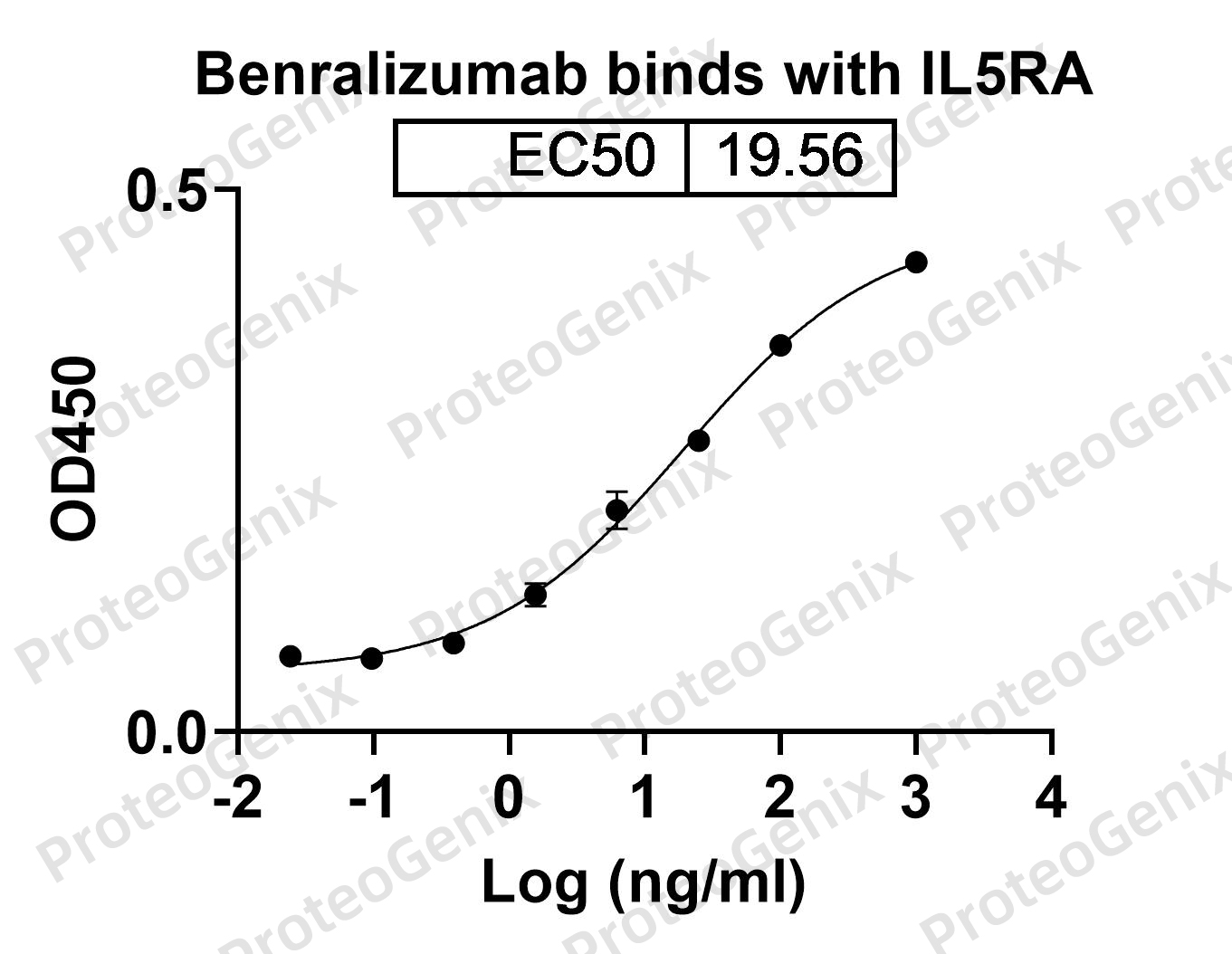
Immobilized IL5RA recombinant protein (cat. No.PX-P5204) at 0.5µg/mL (100µL/well) can bind to Benralizumab Biosimilar - Anti-IL5RA, CD125 mAb (cat. No.PX-TA1240) in indirect ELISA with Goat Anti-Human IgG secondary antibody coupled with HRP measured by OD450
Related products


Send us a message from the form below
Reviews
There are no reviews yet.