Cart (0 Items)
Your cart is currently empty.
View Products



| Size | 100ug, 1MG |
|---|---|
| Isotype | IgG1, kappa |
| Brand | ProteoGenix |
| Product type | Primary Antibodies |
| Clonality | Monoclonal Antibody |
| Expression system | Mammalian cells |
| Applications | Elisa, WB |
| Product name | Loncastuximab Biosimilar - Anti-CD19 mAb - Research Grade |
|---|---|
| Source | CAS 1875032-68-0 |
| Species | Chimeric |
| Purity | >85% |
| Buffer | PBS buffer PH7.5 |
| Delivery condition | Blue ice (+4°C) |
| Delivery Time | 3-5 days if in stock; 3-5 weeks if production needed |
| Storage condition | store at -80°C |
| Brand | ProteoGenix |
| Aliases /Synonyms | Loncastuximab,RB4v1.2,CD19 ,anti-CD19 |
| Reference | PX-TA1481 |
| Note | For research use only. Not suitable for clinical or therapeutic use. |
| Isotype | IgG1, kappa |
| Clonality | Monoclonal Antibody |
Loncastuximab Biosimilar: A Promising Antibody for Targeting CD19 in
Loncastuximab Biosimilar, also known as Anti-CD19 mAb, is a monoclonal antibody that has shown promising results in targeting CD19, a therapeutic target in cancer treatment. This biosimilar is a research grade antibody that has been developed as a potential alternative to the currently available anti-CD19 antibodies. In this article, we will discuss the structure, activity, and application of Loncastuximab Biosimilar in cancer treatment.
Loncastuximab Biosimilar is a chimeric monoclonal antibody, meaning it is composed of both human and non-human components. It is composed of a human IgG1 constant region and a murine variable region. This structure allows the antibody to bind specifically to the CD19 antigen without causing an immune response in the patient.
The antibody has a molecular weight of approximately 150 kDa and a half-life of 21 days. It is produced using recombinant DNA technology and is highly purified to ensure safety and efficacy in clinical applications.
The main activity of Loncastuximab Biosimilar is to target and bind to the CD19 antigen, which is found on the surface of B-cells. This binding triggers a series of events that ultimately leads to the destruction of the B-cells, making it an effective treatment for B-cell malignancies.
Loncastuximab Biosimilar works by two main mechanisms: antibody-dependent cell-mediated cytotoxicity (ADCC) and complement-dependent cytotoxicity (CDC). In ADCC, the antibody binds to the CD19 antigen on the B-cell surface, and the Fc region of the antibody binds to natural killer (NK) cells or macrophages, triggering them to destroy the B-cell. In CDC, the antibody binds to the CD19 antigen and activates the complement system, leading to the destruction of the B-cell.
Studies have shown that Loncastuximab Biosimilar has a high affinity for the CD19 antigen and is able to induce significant B-cell depletion in vitro and in vivo. It has also been found to be effective in targeting CD19-positive B-cell malignancies, such as B-cell lymphomas and leukemias.
Loncastuximab Biosimilar is currently being studied as a potential treatment option for various B-cell malignancies, including non-Hodgkin’s lymphoma, chronic lymphocytic leukemia, and acute lymphoblastic leukemia. It is being evaluated in both monotherapy and combination therapy settings, and early clinical trials have shown promising results.
One of the main advantages of Loncastuximab Biosimilar is its potential to overcome resistance to other anti-CD19 antibodies. Some patients may develop resistance to currently available anti-CD19 antibodies, making it difficult to achieve a complete response. However, early studies have shown that Loncastuximab Biosimilar is effective even in patients who have failed other anti-CD19 therapies.
Furthermore, Loncastuximab Biosimilar is being studied for its potential to be used as a conditioning agent in stem cell transplantation for B-cell malignancies. This could potentially improve the efficacy of stem cell transplantation and reduce the risk of relapse.
Loncastuximab Biosimilar, also known as Anti-CD19 mAb, is a chimeric monoclonal antibody that has shown promising results in targeting CD19 in cancer treatment. Its unique structure and mechanisms of action make it a potential alternative to currently available anti-CD19 antibodies. Further studies and clinical trials are needed to fully understand the potential of this biosimilar in cancer treatment.
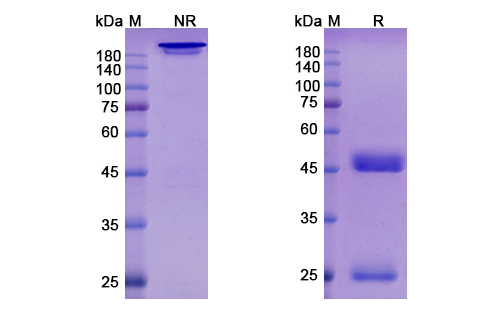
Loncastuximab Biosimilar - Anti-CD19 mAb - Research Grade on SDS-PAGE under reducing and non-reducing conditions. The gel was stained overnight with Coomassie Blue.. The purity of the antibody is greater than 95%.
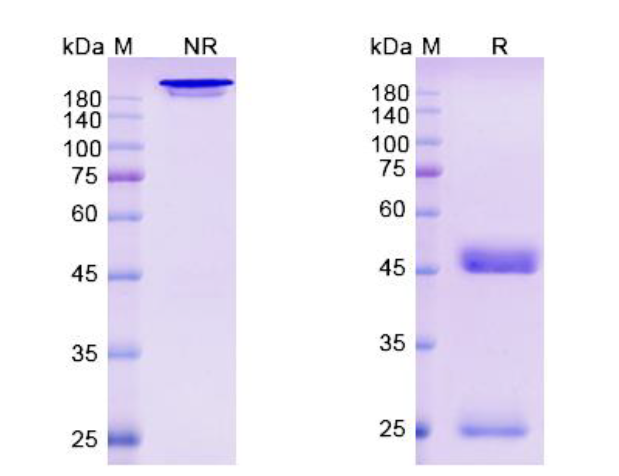
Loncastuximab Biosimilar - Anti-CD19 mAb - Research Grade on SDS-PAGE under reducing and non-reducing conditions. The gel was stained overnight with Coomassie Blue.. The purity of the antibody is greater than 95%.
Related products


Send us a message from the form below
Reviews
There are no reviews yet.