Cart (0 Items)
Your cart is currently empty.
View Products



| Size | 100ug, 10mg, 1MG, 25mg |
|---|---|
| Isotype | IgG2, kappa |
| Brand | ProteoGenix |
| Product type | Primary Antibodies |
| Clonality | Monoclonal Antibody |
| Expression system | Mammalian cells |
| Applications | Elisa, WB |
| Product name | Selicrelumab Biosimilar - Anti-CD40, TNFRSF5 mAb - Research Grade |
|---|---|
| Source | CAS 1622140-49-1 |
| Species | Homo sapiens |
| Purity | >85% |
| Buffer | PBS buffer PH7.5 |
| Delivery condition | Blue ice (+4°C) |
| Delivery lead time in business days | 3-5 days if in stock; 3-5 weeks if production needed |
| Delivery Time | 3-5 days if in stock; 3-5 weeks if production needed |
| Storage condition | store at -80°C |
| Brand | ProteoGenix |
| Aliases /Synonyms | Selicrelumab,CP-870,893,RG-7876,RO-7009789,CD40, TNFRSF5,anti-CD40, TNFRSF5 |
| Reference | PX-TA1465 |
| Note | For research use only. Not suitable for clinical or therapeutic use. |
| Isotype | IgG2, Kappa |
Introduction to Selicrelumab Biosimilar – A Promising Anti-CD40 Antibody for Targeted Therapy Selicrelumab Biosimilar, also known as Anti-CD40, TNFRSF5 mAb, is a monoclonal antibody that has shown great potential as a therapeutic agent for various diseases. This biosimilar is a highly specific and potent inhibitor of CD40, a protein that plays a crucial role in immune response and inflammation. In this article, we will explore the structure, activity, and potential applications of Selicrelumab Biosimilar in the field of targeted therapy.
Selicrelumab Biosimilar is a recombinant humanized monoclonal antibody that is produced using advanced genetic engineering techniques. It is a biosimilar of the original Selicrelumab, which was developed by Pfizer and is currently undergoing clinical trials. The biosimilar has a similar structure to the original antibody, with a few minor modifications to ensure its safety and efficacy.
The antibody has a molecular weight of approximately 150 kDa and consists of two heavy chains and two light chains. The heavy chains are composed of four constant domains (CH1, CH2, CH3, and CH4) and one variable domain (VH), while the light chains contain one constant domain (CL) and one variable domain (VL). The variable domains are responsible for binding to the CD40 protein, while the constant domains provide stability and determine the effector functions of the antibody.
The primary target of Selicrelumab Biosimilar is the CD40 protein, which is found on the surface of various immune cells, including B cells, dendritic cells, and macrophages. When CD40 is activated by its ligand, it triggers a cascade of signaling events that lead to the activation of these immune cells and the production of pro-inflammatory cytokines. This process is essential for immune response and protection against pathogens, but it can also contribute to the development of autoimmune diseases and chronic inflammation.
Selicrelumab Biosimilar binds to CD40 with high affinity and blocks its interaction with its ligand, effectively inhibiting the downstream signaling pathways. This mechanism of action makes it a potent anti-inflammatory agent and a promising therapeutic target for various diseases, including autoimmune disorders, transplant rejection, and cancer.
Selicrelumab Biosimilar has shown promising results in preclinical studies and is currently being evaluated in clinical trials for the treatment of various diseases. One of the most significant potential applications of this biosimilar is in the treatment of autoimmune diseases, such as rheumatoid arthritis, systemic lupus erythematosus, and multiple sclerosis. By blocking CD40 signaling, Selicrelumab Biosimilar can reduce inflammation and prevent tissue damage in these conditions.
Another potential application of Selicrelumab Biosimilar is in the prevention of transplant rejection. CD40 plays a critical role in the activation of immune cells that are responsible for transplant rejection, and Selicrelumab Biosimilar has the potential to inhibit this process and improve the success rate of organ transplantation.
Moreover, Selicrelumab Biosimilar has also shown promising results in the treatment of certain types of cancer. CD40 is overexpressed on the surface of some tumor cells, and Selicrelumab Biosimilar can target and kill these cells directly, while also activating the immune system to mount an anti-tumor response.
In conclusion, Selicrelumab Biosimilar is a novel monoclonal antibody that has shown great potential as a targeted therapy for various diseases. Its unique structure and mechanism of action make it a potent inhibitor of CD40, a protein that plays a crucial role in immune response and inflammation. With ongoing clinical trials, Selicrelumab Biosimilar has the potential to become a valuable treatment option for patients with autoimmune diseases, transplant recipients, and cancer patients.
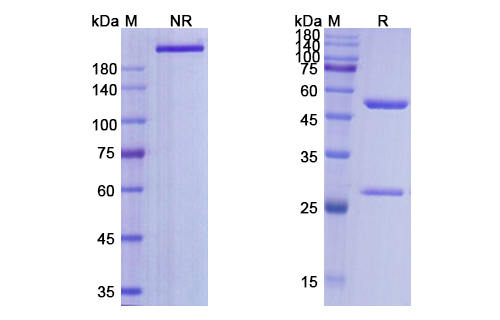
Selicrelumab Biosimilar - Anti-CD40; TNFRSF5 mAb - Research Grade on SDS-PAGE under reducing and non-reducing conditions. The gel was stained overnight with Coomassie Blue.. The purity of the antibody is greater than 95%.
Related products


Send us a message from the form below
Reviews
There are no reviews yet.