Cart (0 Items)
Your cart is currently empty.
View Products



| Size | 100ug, 1MG |
|---|---|
| Isotype | IgG1-nd |
| Brand | ProteoGenix |
| Product type | Primary Antibodies |
| Clonality | Monoclonal Antibody |
| Expression system | Mammalian cells |
| Applications | Elisa, WB |
| Product name | Teprotumumab Biosimilar - Anti-IGF1R, CD221 mAb - Research Grade |
|---|---|
| Source | CAS 1036734-93-6 |
| Species | Homo sapiens |
| Molecular weight | 148kDa |
| Purity | >85% |
| Buffer | PBS buffer PH7.5 |
| Delivery condition | Blue ice (+4°C) |
| Delivery Time | 3-5 days if in stock; 3-5 weeks if production needed |
| Storage condition | store at -80°C |
| Brand | ProteoGenix |
| Aliases /Synonyms | Teprotumumab,RO4858696-000,IGF1R, CD221,anti-IGF1R, CD221 |
| Reference | PX-TA1242 |
| Note | For research use only. Not suitable for clinical or therapeutic use. |
| Isotype | IgG1-nd |
| Clonality | Monoclonal Antibody |
Teprotumumab Biosimilar, also known as Anti-IGF1R, CD221 mAb, is a monoclonal antibody that targets the insulin-like growth factor 1 receptor (IGF1R) and cluster of differentiation 221 (CD221). It is a biosimilar of the FDA-approved drug Teprotumumab, which is used for the treatment of thyroid eye disease.
The structure of Teprotumumab Biosimilar is composed of two heavy chains and two light chains, linked together by disulfide bonds. The heavy chains consist of a constant region and a variable region, while the light chains have only a variable region. The variable regions of both the heavy and light chains are responsible for binding to the IGF1R and CD221 receptors.
Teprotumumab Biosimilar works by binding to IGF1R and CD221 receptors, which are highly expressed on the surface of thyroid eye disease cells. This binding inhibits the activity of these receptors, leading to a decrease in the production of inflammatory cytokines and an increase in the production of anti-inflammatory cytokines. This ultimately results in a reduction of inflammation and tissue damage in the eye.
In addition to its anti-inflammatory activity, Teprotumumab Biosimilar also has anti-proliferative effects. It inhibits the growth and proliferation of cells that overexpress IGF1R and CD221, which is a common characteristic of thyroid eye disease.
Teprotumumab Biosimilar is primarily used as a therapeutic agent for the treatment of thyroid eye disease. This condition is characterized by inflammation and tissue damage in the eye, which can lead to vision impairment and disfigurement. Teprotumumab Biosimilar works by targeting the underlying cause of the disease, the overexpression of IGF1R and CD221 receptors.
In addition to its use in thyroid eye disease, Teprotumumab Biosimilar has also shown potential in the treatment of other diseases that involve IGF1R and CD221 overexpression, such as certain types of cancer. Clinical trials are currently ongoing to investigate its efficacy in these conditions.
Teprotumumab Biosimilar, also known as Anti-IGF1R, CD221 mAb, is a monoclonal antibody with a specific structure and activity. It works by binding to IGF1R and CD221 receptors, inhibiting their activity and reducing inflammation and tissue damage in the eye. Its primary application is in the treatment of thyroid eye disease, but it also shows potential in other diseases involving IGF1R and CD221 overexpression. Further research and clinical trials are needed to fully understand the potential of this biosimilar in various therapeutic settings.
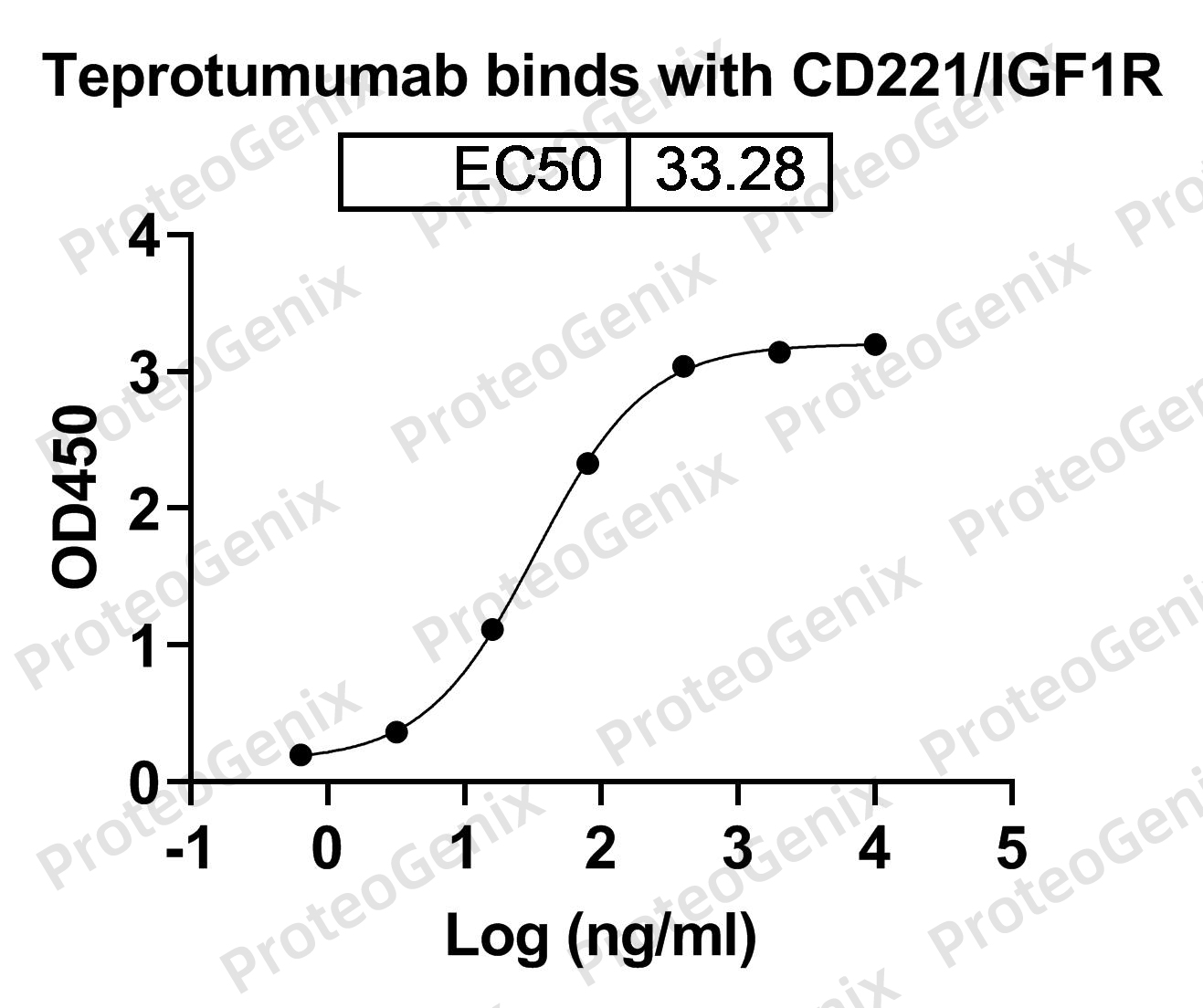
Immobilized IGF1R recombinant protein (cat. No.PX-P5185) at 0.5µg/mL (100µL/well) can bind Teprotumumab Biosimilar - Anti-IGF1R, CD221 mAb - Research Grade (cat. No.PX-TA1242) in indirect ELISA with Goat Anti-Human IgG secondary antibody coupled with HRP measured by OD450 giving an EC50 at 33.28M.
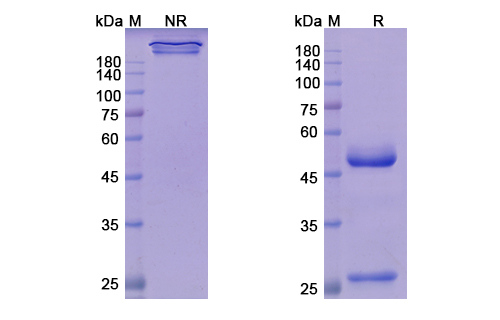
Teprotumumab Biosimilar - Anti-IGF1R, CD221 mAb - Research Grade on SDS-PAGE under reducing and non-reducing conditions. The gel was stained overnight with Coomassie Blue.. The purity of the antibody is greater than 95%.
Related products



Send us a message from the form below
Reviews
There are no reviews yet.