Cart (0 Items)
Your cart is currently empty.
View Products



| Size | 100ug, 1MG |
|---|---|
| Isotype | IgG1, kappa |
| Brand | ProteoGenix |
| Product type | Primary Antibodies |
| Clonality | Monoclonal Antibody |
| Expression system | Mammalian cells |
| Applications | Elisa, WB |
| Product name | Vofatamab Biosimilar - Anti-FGFR3 mAb - Research Grade |
|---|---|
| Source | CAS 1312305-12-6 |
| Species | Humanized |
| Purity | >85% |
| Buffer | PBS buffer PH7.5 |
| Delivery condition | Blue ice (+4°C) |
| Delivery Time | 3-5 days if in stock; 3-5 weeks if production needed |
| Storage condition | store at -80°C |
| Brand | ProteoGenix |
| Aliases /Synonyms | Vofatamab ,MFGR1877S,FGFR3,anti-FGFR3 |
| Reference | PX-TA1548 |
| Note | For research use only. Not suitable for clinical or therapeutic use. |
| Isotype | IgG1, kappa |
| Clonality | Monoclonal Antibody |
Vofatamab Biosimilar, also known as Anti-FGFR3 mAb, is a research grade monoclonal antibody that targets the Fibroblast Growth Factor Receptor 3 (FGFR3) protein. This antibody has gained significant attention in the scientific community due to its potential therapeutic applications in various diseases. In this article, we will explore the structure, activity, and potential applications of Vofatamab Biosimilar.
Vofatamab Biosimilar is a monoclonal antibody, which means it is produced by a single clone of B cells and is identical in structure and function. It is composed of two heavy chains and two light chains, which are connected by disulfide bonds. The antibody has a Y-shaped structure, with the two arms of the Y being the antigen-binding sites. These sites are responsible for recognizing and binding to the FGFR3 protein.
The main activity of Vofatamab Biosimilar is its ability to bind to the FGFR3 protein. FGFR3 is a receptor tyrosine kinase that plays a crucial role in cell growth, differentiation, and survival. However, mutations in the FGFR3 gene have been linked to various diseases, including cancer. Vofatamab Biosimilar binds to the extracellular domain of FGFR3, preventing its activation and downstream signaling. This inhibition of FGFR3 signaling can lead to the suppression of cell growth and proliferation, making Vofatamab Biosimilar a potential therapeutic agent.
1.
One of the most promising applications of Vofatamab Biosimilar is in the treatment of cancer. FGFR3 mutations have been identified in several types of cancer, including bladder cancer, multiple myeloma, and lung cancer. By inhibiting the activity of FGFR3, Vofatamab Biosimilar can potentially slow down or stop the growth of cancer cells, making it a potential treatment option for these cancers.
2. Skeletal Dysplasia:
FGFR3 mutations are also associated with skeletal dysplasia, a group of rare genetic disorders that affect bone growth and development. These mutations can lead to abnormal bone growth, resulting in conditions such as achondroplasia and hypochondroplasia. Vofatamab Biosimilar has shown promising results in preclinical studies for the treatment of skeletal dysplasia, making it a potential therapy for these conditions.
3. Bladder Conditions:
FGFR3 mutations have also been linked to bladder conditions, such as bladder cancer and interstitial cystitis. Vofatamab Biosimilar has shown potential in the treatment of interstitial cystitis by inhibiting the activity of FGFR3 and reducing inflammation in the bladder. Further studies are needed to determine its efficacy in treating bladder cancer.
4. Other Diseases:
Apart from the above-mentioned conditions, FGFR3 mutations have also been implicated in other diseases, such as rheumatoid arthritis, psoriasis, and endometriosis. Vofatamab Biosimilar has shown potential in preclinical studies for the treatment of these diseases by targeting the underlying FGFR3 mutations.
In conclusion, Vofatamab Biosimilar, also known as Anti-FGFR3 mAb, is a research grade monoclonal antibody that targets the FGFR3 protein. Its structure, activity, and potential applications make it a promising therapeutic agent for various diseases, including cancer, skeletal dysplasia, and bladder conditions. Further research and clinical trials are needed to fully understand the efficacy and safety of Vofatamab Biosimilar in these diseases.
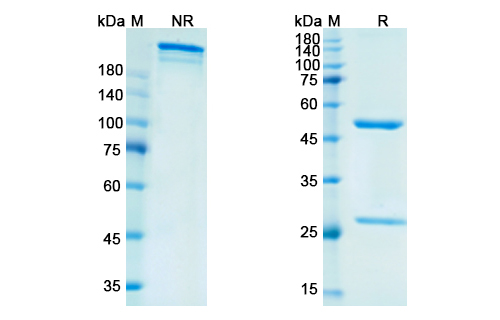
Vofatamab Biosimilar - Anti-FGFR3 mAb - Research Grade on SDS-PAGE under reducing and non-reducing conditions. The gel was stained overnight with Coomassie Blue.. The purity of the antibody is greater than 95%.
Related products



Send us a message from the form below
Reviews
There are no reviews yet.