Cart (0 Items)
Your cart is currently empty.
View Products



| Size | 100ug, 1MG |
|---|---|
| Isotype | IgG1, lambda |
| Brand | ProteoGenix |
| Product type | Primary Antibodies |
| Clonality | Monoclonal Antibody |
| Expression system | Mammalian cells |
| Applications | Elisa, WB |
| Product name | Drozitumab Biosimilar - Anti-TNFRSF10B, TRAILR2, CD262 mAb - Research Grade |
|---|---|
| Source | CAS 912628-39-8 |
| Species | Homo sapiens |
| Purity | >85% |
| Buffer | PBS buffer PH7.5 |
| Delivery condition | Blue ice (+4°C) |
| Delivery Time | 3-5 days if in stock; 3-5 weeks if production needed |
| Storage condition | store at -80°C |
| Brand | ProteoGenix |
| Aliases /Synonyms | Drozitumab,PRO95780,anti-DR5,rhuMAb DR5,TNFRSF10B, TRAILR2, CD262,anti-TNFRSF10B, TRAILR2, CD262 |
| Reference | PX-TA1243 |
| Note | For research use only. Not suitable for clinical or therapeutic use. |
| Isotype | IgG1, lambda |
| Clonality | Monoclonal Antibody |
Drozitumab Biosimilar is a monoclonal antibody (mAb) that targets the tumor necrosis factor receptor superfamily member 10B (TNFRSF10B), also known as TRAILR2 or CD262. This biosimilar is a research grade version of the original drug, Drozitumab, which is currently in clinical trials for the treatment of various types of cancer. In this article, we will explore the structure, activity, and potential applications of Drozitumab Biosimilar as an antibody targeting TNFRSF10B.
Drozitumab Biosimilar is a fully humanized IgG1 monoclonal antibody, meaning that it is derived from human cells and has a constant region of the immunoglobulin G1 isotype. The antibody has a molecular weight of approximately 150 kDa and is composed of two heavy chains and two light chains. The variable regions of the antibody are responsible for its specificity towards TNFRSF10B, while the constant regions play a role in its effector functions.
The primary function of Drozitumab Biosimilar is to bind to TNFRSF10B and block its activity. TNFRSF10B is a cell surface receptor that is involved in the regulation of apoptosis, or programmed cell death. When TNFRSF10B is activated by its ligand, TRAIL (tumor necrosis factor-related apoptosis-inducing ligand), it triggers a signaling cascade that leads to cell death. This process is important for maintaining tissue homeostasis and eliminating damaged or abnormal cells. However, in cancer cells, TNFRSF10B is often overexpressed, leading to excessive cell death and tumor growth. By binding to TNFRSF10B, Drozitumab Biosimilar can inhibit this signaling pathway and potentially slow down or stop the growth of cancer cells.
As a biosimilar of Drozitumab, this antibody has the potential to be used in a similar manner for the treatment of cancer. Some of the potential applications of Drozitumab Biosimilar include:
1. Targeted therapy for solid tumors: TNFRSF10B is overexpressed in many types of solid tumors, including breast, lung, and colon cancer. By targeting this receptor, Drozitumab Biosimilar could potentially be used as a targeted therapy to specifically kill cancer cells while sparing normal cells.
2. Combination therapy with other cancer treatments: Drozitumab Biosimilar could also be used in combination with other cancer treatments, such as chemotherapy or radiation therapy. By blocking TNFRSF10B, it could sensitize cancer cells to these treatments and enhance their effectiveness.
3. Immunotherapy for hematologic malignancies: TNFRSF10B is also expressed on the surface of some types of blood cancer cells, such as multiple myeloma and acute myeloid leukemia. Drozitumab Biosimilar could potentially be used as an immunotherapy to target and kill these cancer cells.
4. Research tool for studying TNFRSF10B: In addition to its potential therapeutic applications, Drozitumab Biosimilar can also be used as a research tool for studying TNFRSF10B and its role in cancer. Its high specificity and affinity for TNFRSF10B make it a valuable tool for studying the function of this receptor and its potential as a therapeutic target.
In summary, Drozitumab Biosimilar is a research grade monoclonal antibody that specifically targets TNFRSF10B, a receptor involved in the regulation of cell death. Its structure, activity, and potential applications make it a promising candidate for the treatment of various types of cancer. Further research and clinical trials will be needed to fully explore the potential of this biosimilar as a therapeutic agent.
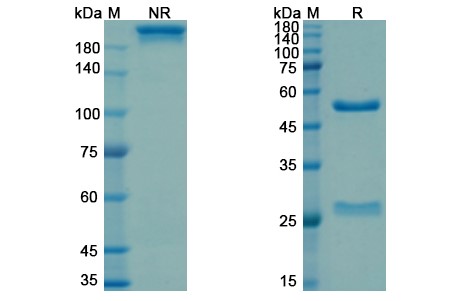
Drozitumab Biosimilar - Anti-CD262;TRAIL-R2;DR5 mAb - Research Grade on SDS-PAGE under reducing and non-reducing conditions. The gel was stained overnight with Coomassie Blue.. The purity of the antibody is greater than 95%.
Related products



Send us a message from the form below
Reviews
There are no reviews yet.