Cart (0 Items)
Your cart is currently empty.
View Products



| Size | 100ug, 1MG |
|---|---|
| Isotype | IgG1, kappa |
| Brand | ProteoGenix |
| Product type | Primary Antibodies |
| Clonality | Monoclonal Antibody |
| Expression system | Mammalian cells |
| Applications | Elisa, WB |
| Product name | Lacnotuzumab Biosimilar - Anti-CSF1, MCSF mAb - Research Grade |
|---|---|
| Source | CAS 1831128-32-5 |
| Species | Humanized |
| Purity | >85% |
| Buffer | PBS buffer PH7.5 |
| Delivery condition | Blue ice (+4°C) |
| Delivery Time | 3-5 days if in stock; 3-5 weeks if production needed |
| Storage condition | store at -80°C |
| Brand | ProteoGenix |
| Aliases /Synonyms | Lacnotuzumab,MCS-110,CSF1, MCSF,anti-CSF1, MCSF |
| Reference | PX-TA1466 |
| Note | For research use only. Not suitable for clinical or therapeutic use. |
| Isotype | IgG1, kappa |
| Clonality | Monoclonal Antibody |
Lacnotuzumab Biosimilar, also known as Anti-CSF1 or MCSF mAb, is a monoclonal antibody that has been developed as a potential therapeutic agent for the treatment of various diseases. This biosimilar is a highly specific and potent inhibitor of Colony Stimulating Factor 1 (CSF1), a cytokine that plays a crucial role in the regulation of immune response and inflammation. In this article, we will discuss the structure, activity, and potential applications of Lacnotuzumab Biosimilar as a research-grade antibody.
Lacnotuzumab Biosimilar is a recombinant humanized monoclonal antibody, meaning that it is produced in the laboratory using recombinant DNA technology and has been engineered to be more similar to human antibodies. It is composed of two identical light chains and two identical heavy chains, each containing variable and constant regions. The variable regions of the antibody are responsible for binding to the target molecule, CSF1, while the constant regions determine the antibody’s effector functions.
The main activity of Lacnotuzumab Biosimilar is the inhibition of CSF1. CSF1 is a cytokine that is produced by various cell types, including macrophages, monocytes, and osteoblasts. It plays a crucial role in the regulation of immune response, inflammation, and bone metabolism. CSF1 binds to its receptor, CSF1R, on the surface of target cells, leading to the activation of downstream signaling pathways that promote cell growth, survival, and differentiation.
Lacnotuzumab Biosimilar binds to CSF1 with high specificity and affinity, preventing its interaction with CSF1R and inhibiting its activity. This results in the suppression of CSF1-mediated signaling, leading to the inhibition of immune response and inflammation. Additionally, Lacnotuzumab Biosimilar has been shown to have direct effects on osteoclasts, the cells responsible for bone resorption, leading to a potential application in the treatment of bone-related diseases.
Lacnotuzumab Biosimilar has shown promising results in preclinical studies and is currently being evaluated in clinical trials for the treatment of various diseases, including rheumatoid arthritis, osteoarthritis, and osteoporosis. As a research-grade antibody, it is also being used in laboratory studies to investigate the role of CSF1 in different disease states.
1.
Rheumatoid arthritis (RA) is a chronic autoimmune disease characterized by inflammation of the joints, leading to pain, stiffness, and joint damage. CSF1 has been implicated in the pathogenesis of RA, as it promotes the differentiation and activation of macrophages, which play a key role in the inflammatory response in RA. By inhibiting CSF1, Lacnotuzumab Biosimilar has the potential to reduce inflammation and joint damage in RA patients.
2.
Osteoarthritis (OA) is a degenerative joint disease that is characterized by the breakdown of cartilage in the joints. CSF1 has been shown to play a role in the development and progression of OA by promoting the production of enzymes that degrade cartilage. In preclinical studies, Lacnotuzumab Biosimilar has been shown to reduce cartilage damage and improve joint function in OA models, making it a potential therapeutic target for this disease.
3.
Osteoporosis is a condition characterized by low bone mass and structural deterioration of bone tissue, leading to an increased risk of fractures. CSF1 has been shown to play a role in the regulation of bone metabolism, and its inhibition by Lacnotuzumab Biosimilar has been shown to increase bone density and prevent bone loss in
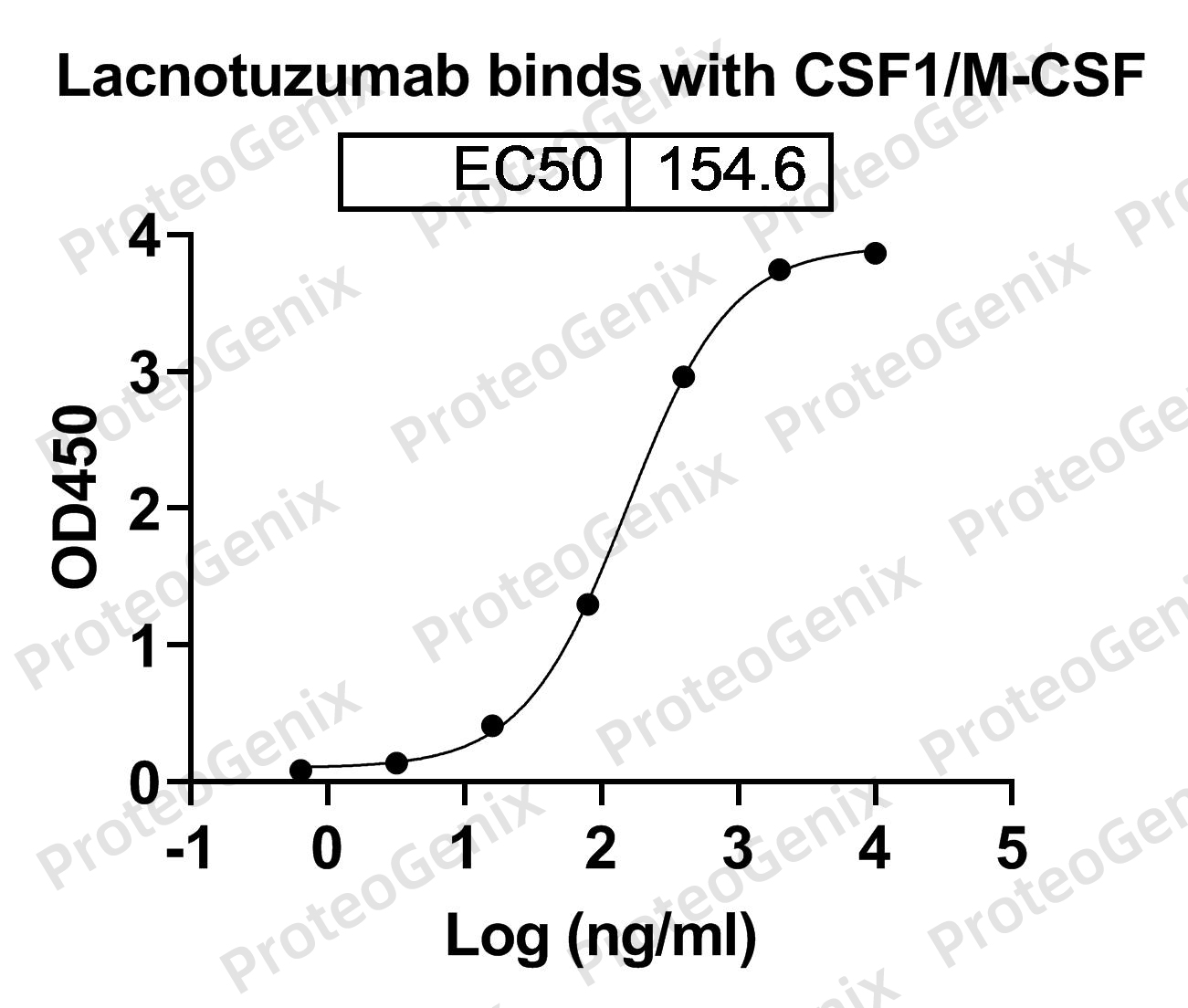
Immobilized CSF1 / M-CSF (in Mammalian), N-His, recombinant protein (cat. No.PX-P5665) at 0.5µg/mL (100µL/well) can bind to Lacnotuzumab Biosimilar - Anti-CSF1, MCSF mAb (cat. No.PX-TA1466) in indirect ELISA with Goat Anti-Human IgG secondary antibody coupled with HRP measured by OD450
Related products



Send us a message from the form below
Reviews
There are no reviews yet.