Cart (0 Items)
Your cart is currently empty.
View Products



| Size | 100ug, 1MG |
|---|---|
| Isotype | IgG1, kappa |
| Brand | ProteoGenix |
| Product type | Primary Antibodies |
| Clonality | Monoclonal Antibody |
| Expression system | Mammalian cells |
| Applications | Elisa, WB |
| Product name | Lintuzumab Biosimilar - Anti-CD33 mAb - Research Grade |
|---|---|
| Source | CAS 166089-32-3 |
| Species | Humanized |
| Purity | >85% |
| Buffer | PBS buffer PH7.5 |
| Delivery condition | Blue ice (+4°C) |
| Delivery Time | 3-5 days if in stock; 3-5 weeks if production needed |
| Storage condition | store at -80°C |
| Brand | ProteoGenix |
| Aliases /Synonyms | Lintuzumab,225Ac-lintuzumab,HuM195,SGN-33,SMART M195,CD33,anti-CD33 |
| Reference | PX-TA1046 |
| Note | For research use only. Not suitable for clinical or therapeutic use. |
| Isotype | IgG1, kappa |
| Clonality | Monoclonal Antibody |
Lintuzumab Biosimilar, also known as Anti-CD33 mAb, is a monoclonal antibody that has been developed as a potential therapeutic agent for the treatment of various types of cancer. This biosimilar is a research grade version of the FDA-approved drug, Lintuzumab, which is currently used for the treatment of acute myeloid leukemia (AML). In this article, we will discuss the structure, activity, and potential applications of Lintuzumab Biosimilar in the field of cancer research.
Lintuzumab Biosimilar is a recombinant, humanized monoclonal antibody that specifically targets the CD33 antigen. The CD33 antigen is a transmembrane glycoprotein that is expressed on the surface of myeloid cells, including leukemic blasts in AML. The antibody is composed of two identical heavy chains and two identical light chains, each containing variable and constant regions. The variable regions of the antibody are responsible for binding to the CD33 antigen, while the constant regions determine the effector functions of the antibody.
The primary mechanism of action of Lintuzumab Biosimilar is through its binding to the CD33 antigen on the surface of leukemic cells. This binding triggers a series of events that lead to the destruction of the cancer cells. The antibody can also induce antibody-dependent cell-mediated cytotoxicity (ADCC) and complement-dependent cytotoxicity (CDC) by recruiting immune cells and complement proteins to the site of the cancer cells. This results in the killing of cancer cells through various immune mechanisms.
Lintuzumab Biosimilar has shown promising results in preclinical and clinical studies as a potential therapeutic agent for the treatment of AML and other CD33-positive malignancies. In addition, the biosimilar has also shown potential in combination therapies with other chemotherapeutic agents, such as cytarabine and daunorubicin, for the treatment of AML. Furthermore, Lintuzumab Biosimilar has also been investigated in clinical trials for the treatment of other hematological malignancies, including myelodysplastic syndrome (MDS) and myelofibrosis.
One of the major advantages of Lintuzumab Biosimilar is its specificity towards the CD33 antigen, which is highly expressed on leukemic cells but not on normal hematopoietic stem cells. This allows for targeted therapy, minimizing the potential side effects on healthy cells. Additionally, the biosimilar has a favorable safety profile and has shown minimal immunogenicity in clinical trials.
In conclusion, Lintuzumab Biosimilar is a promising therapeutic agent for the treatment of CD33-positive malignancies, particularly AML. Its specific targeting of the CD33 antigen and potential for combination therapy make it a valuable addition to the current treatment options for these cancers. Further research and clinical trials are needed to fully understand the potential of this biosimilar in cancer treatment.
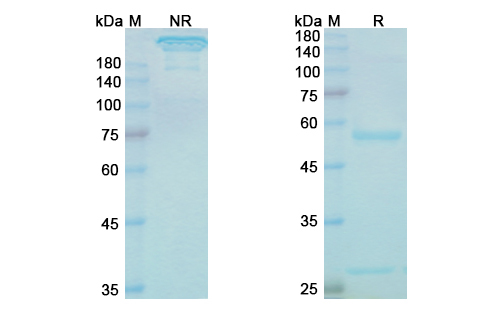
Lintuzumab Biosimilar - Anti-CD33 mAb - Research Grade on SDS-PAGE under reducing and non-reducing conditions. The gel was stained overnight with Coomassie Blue.. The purity of the antibody is greater than 95%.
Related products



Send us a message from the form below
Reviews
There are no reviews yet.