Cart (0 Items)
Your cart is currently empty.
View Products



| Size | 100ug, 1MG |
|---|---|
| Isotype | IgG1, kappa |
| Brand | ProteoGenix |
| Product type | Primary Antibodies |
| Clonality | Monoclonal Antibody |
| Expression system | Mammalian cells |
| Applications | Elisa, WB |
| Product name | Rosmantuzumab Biosimilar - Anti-RSPO3 mAb - Research Grade |
|---|---|
| Source | CAS 1684393-04-1 |
| Species | Humanized |
| Purity | >85% |
| Buffer | PBS buffer PH7.5 |
| Delivery condition | Blue ice (+4°C) |
| Delivery lead time in business days | 3-5 days if in stock; 3-5 weeks if production needed |
| Delivery Time | 3-5 days if in stock; 3-5 weeks if production needed |
| Storage condition | store at -80°C |
| Brand | ProteoGenix |
| Aliases /Synonyms | Rosmantuzumab,OMP-131R10,RSPO3,anti-RSPO3 |
| Reference | PX-TA1446 |
| Note | For research use only. Not suitable for human use. |
| Isotype | IgG1, kappa |
| Clonality | Monoclonal Antibody |
Rosmantuzumab Biosimilar, also known as Anti-RSPO3 mAb, is a research grade antibody that has shown promising results in targeting and inhibiting the activity of RSPO3, a protein involved in the Wnt signaling pathway. This pathway plays a crucial role in cell proliferation and differentiation, and dysregulation of the pathway has been linked to various diseases, including cancer. In this article, we will explore the structure, activity, and potential applications of Rosmantuzumab Biosimilar as a therapeutic target.
Rosmantuzumab Biosimilar is a monoclonal antibody, meaning it is produced by a single type of immune cell and has a highly specific binding affinity for its target. It is a recombinant protein, meaning it is produced through genetic engineering techniques. The antibody is composed of two heavy chains and two light chains, each with a specific amino acid sequence that determines its structure and function.
The variable regions of the antibody, also known as the antigen-binding regions, are responsible for recognizing and binding to the target molecule, RSPO3. These regions are highly specific and allow the antibody to bind to RSPO3 with high affinity and specificity.
The constant regions of the antibody, on the other hand, are responsible for the effector functions of the antibody, such as activating the immune system to attack and destroy the target molecule. These regions are also important for the stability and half-life of the antibody in the body.
Rosmantuzumab Biosimilar works by binding to RSPO3 and preventing it from activating the Wnt signaling pathway. This inhibits the proliferation and survival of cancer cells that rely on this pathway for growth and survival. In addition, the antibody can also induce antibody-dependent cellular cytotoxicity (ADCC), where immune cells are activated to attack and destroy the RSPO3-expressing cells.
Studies have shown that Rosmantuzumab Biosimilar has a high binding affinity for RSPO3 and can effectively inhibit its activity. It has also been found to be well-tolerated and safe in preclinical studies, with minimal side effects.
As a therapeutic target, Rosmantuzumab Biosimilar has potential applications in various diseases, particularly in cancers that are driven by the Wnt signaling pathway. This includes colorectal cancer, gastric cancer, and hepatocellular carcinoma, among others.
Currently, Rosmantuzumab Biosimilar is being evaluated in clinical trials as a potential treatment for advanced solid tumors. Early results have shown promising anti-tumor activity, with some patients experiencing partial or complete responses to the treatment.
In addition to its potential as a cancer treatment, Rosmantuzumab Biosimilar may also have applications in other diseases where the Wnt signaling pathway is dysregulated, such as osteoporosis and fibrosis. Further research and clinical trials are needed to fully explore the potential of this antibody in these areas.
Rosmantuzumab Biosimilar is a research grade antibody that has shown promising results in targeting and inhibiting RSPO3, a protein involved in the Wnt signaling pathway. Its specific structure and high binding affinity make it a promising therapeutic target for various diseases, particularly cancers driven by the Wnt pathway. With ongoing research and clinical trials, Rosmantuzumab Biosimilar has the potential to become an effective treatment option for patients in need.
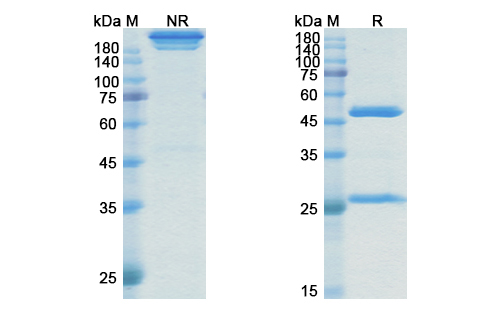
Rosmantuzumab Biosimilar - Anti-RSPO3 mAb - Research Grade on SDS-PAGE under reducing and non-reducing conditions. The gel was stained overnight with Coomassie Blue.. The purity of the antibody is greater than 95%.
Related products

Send us a message from the form below
Reviews
There are no reviews yet.