Cart (0 Items)
Your cart is currently empty.
View Products



| size | 100ug, 50ug |
|---|---|
| Brand | ProteoGenix |
| Product type | Recombinant Proteins |
| Host Species | Mammalian cells |
| Applications | Elisa, WB |
| Product name | Human PDL1, B7-H1, CD274 recombinant protein |
|---|---|
| Uniprot ID | Q9NZQ7 |
| Uniprot link | http://www.uniprot.org/uniprot/Q9NZQ7 |
| Origin species | Homo sapiens (Human) |
| Expression system | Eukaryotic expression |
| Sequence | MRIFAVFIFMTYWHLLNAFTVTVPKDLYVVEYGSNMTIECKFPVEKQLDLAALIVYWEMEDKNIIQFVHGEEDLKVQHSSYRQRARLLKDQLSLGNAALQITDVKLQDAGVYRCMISYGGADYKRITVKVNAPYNKINQRILVVDPVTSEHELTCQAEGYPKAEVIWTSSDHQVLSGKTTTTNSKREEKLFNVTSTLRINTTTNEIFYCTFRRLDPEENHTAELVIPELPLAHPPNERGSHHHHHH |
| Molecular weight | 28.73kDa |
| Protein delivered with Tag? | C-Terminal His Tag |
| Purity estimated | 90% |
| Buffer | 50 mM Tris-HCl pH 8, 150 mM NaCl |
| Form | Lyophilized |
| Delivery condition | Dry Ice |
| Delivery lead time in business days | 5-7 |
| Storage condition | 4°C for short term (1 week), -20°C or -80°C for long term (avoid freezing/thawing cycles; addition of 20-40% glycerol improves cryoprotection) |
| Brand | ProteoGenix |
| Host species | Mammalian cells |
| Fragment Type | Met1-Arg238 |
| Aliases /Synonyms | PDL1, Programmed cell death 1 ligand 1, CD274, B7-H, B7H1, PD-L1, PDCD1L1, PDCD1-LG1, Programed Death Ligand 1 |
| Reference | PX-P4038 |
| Note | For research use only |
Programmed death ligand 1 (PD-L1), also known as cluster of differentiation 274 (CD274) or B7 homolog 1 (B7-H1), is a protein encoded by the CD274 gene in humans. It is a member of the B7 family in the immunoglobulin receptor superfamily. It is expressed on T cells, B cells, NK cells, dendritic cells, endothelial cells and IFN-γ activated monocytes.
Programmed Death Ligand 1 (PD-L1) is a transmembrane protein that is believed to inhibit immune system adaptation during specific events (such as pregnancy, ectopic tissue disease, autoimmune disease, and other diseases such as hepatitis). In general, the adaptive immune system reacts to antigens associated with the immune system through dangerous exogenous or endogenous activities. In turn, clonal expansion of antigen-specific CD8 + T cells and / or CD4 + helper cells is widespread. The binding of PD-L1 to the inhibitory control molecule PD-1 transmits an inhibitory signal through the interaction of a tyrosine-based immunoreceptor (ITSM) motif with phosphatase (SHP-1 or SHP-2). This reduces the proliferation of antigen-specific T cells in ganglia and at the same time reduces the apoptosis of regulatory T cells (anti-inflammatory and inhibitory T cells), further mediated by lower regulation of the Bcl-2 gene.
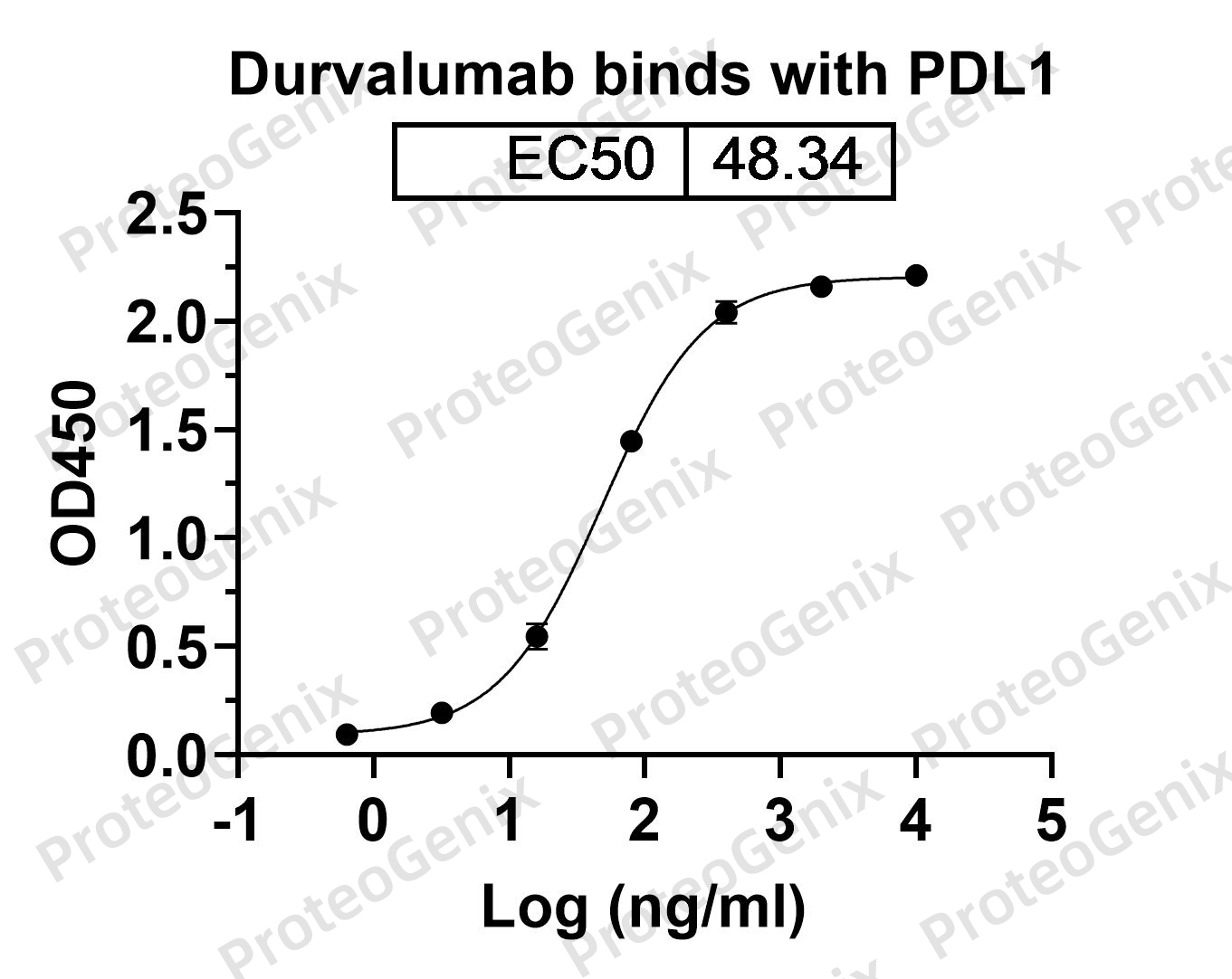
Immobilized Human PDL1, B7-H1, CD274 recombinant protein (cat. No.PX-P4038) at 0.5µg/mL (100µL/well) can bind to Durvalumab Biosimilar - Anti-PD-L1 mAb (cat. No.PX-TA1002) in indirect ELISA with Goat Anti-Human IgG secondary antibody coupled with HRP measured by OD450
Related products


Send us a message from the form below
Reviews
There are no reviews yet.