Cart (0 Items)
Your cart is currently empty.
View Products



| Size | 100ug, 1MG |
|---|---|
| Isotype | IgG1, kappa |
| Brand | ProteoGenix |
| Product type | Primary Antibodies |
| Clonality | Monoclonal Antibody |
| Expression system | Mammalian cells |
| Applications | Elisa, WB |
| Product name | Omburtamab Biosimilar - Anti-CD276, B7-H3, B7RP-2 mAb - Research Grade |
|---|---|
| Source | CAS 1895083-75-6 |
| Species | Mus musculus |
| Purity | >85% |
| Buffer | PBS buffer PH7.5 |
| Delivery condition | Blue ice (+4°C) |
| Delivery Time | 3-5 days if in stock; 3-5 weeks if production needed |
| Storage condition | store at -80°C |
| Brand | ProteoGenix |
| Aliases /Synonyms | Omburtamab,8H9,Mab 8H9,CD276, B7-H3, B7RP-2,anti-CD276, B7-H3, B7RP-2 |
| Reference | PX-TA1532 |
| Note | For research use only. Not suitable for clinical or therapeutic use. |
| Isotype | IgG1, kappa |
| Clonality | Monoclonal Antibody |
Omburtamab Biosimilar, also known as Anti-CD276, B7-H3, B7RP-2 mAb, is a monoclonal antibody that has been developed as a biosimilar to the original Omburtamab antibody. It is a research grade antibody that specifically targets the CD276, B7-H3, and B7RP-2 proteins. In this article, we will discuss the structure, activity, and potential applications of Omburtamab Biosimilar.
Omburtamab Biosimilar is a monoclonal antibody, which means it is made from identical immune cells that are all clones of a unique parent cell. The antibody has a Y-shaped structure, with two arms and a tail. The two arms are known as the Fab region and are responsible for binding to the specific target proteins, CD276, B7-H3, and B7RP-2. The tail of the antibody is called the Fc region and is responsible for activating the immune system.
Omburtamab Biosimilar is designed to target CD276, B7-H3, and B7RP-2 proteins, which are all part of the B7 family of proteins. These proteins are known to play a role in immune regulation and have been found to be overexpressed in various types of cancer. Omburtamab Biosimilar binds to these proteins, blocking their activity and preventing them from promoting tumor growth and suppressing the immune response.
In addition to its direct effects on the B7 proteins, Omburtamab Biosimilar also has an indirect effect on the immune system. The Fc region of the antibody can bind to immune cells, such as natural killer cells and macrophages, and activate them to attack cancer cells. This dual mechanism of action makes Omburtamab Biosimilar a powerful therapeutic agent in the fight against cancer.
Omburtamab Biosimilar has shown promising results in preclinical studies and is currently being evaluated in clinical trials for the treatment of various types of cancer. One of the main applications of this antibody is in the treatment of neuroblastoma, a type of childhood cancer that affects the nervous system. CD276, B7-H3, and B7RP-2 proteins are highly expressed in neuroblastoma cells, making them ideal targets for Omburtamab Biosimilar.
Apart from neuroblastoma, Omburtamab Biosimilar has also shown potential in the treatment of other types of cancer, such as melanoma, lung cancer, and ovarian cancer. The antibody has also been investigated for its potential use in combination with other cancer therapies, such as chemotherapy and radiation therapy.
In addition to its role as a therapeutic agent, Omburtamab Biosimilar can also be used in research studies to further understand the role of CD276, B7-H3, and B7RP-2 proteins in cancer development and progression. It can also be used as a diagnostic tool to detect the presence of these proteins in cancer cells.
In summary, Omburtamab Biosimilar is a research grade monoclonal antibody that specifically targets CD276, B7-H3, and B7RP-2 proteins, which are known to play a role in cancer development and progression. The antibody has a dual mechanism of action, both directly targeting the B7 proteins and indirectly activating the immune system. It has shown promising results in preclinical and clinical studies and has the potential to be used in the treatment of various types of cancer. Furthermore, Omburtamab Biosimilar can also be used in research and diagnostic applications. With ongoing research, this biosimilar has the potential to make a significant impact in the fight against cancer.
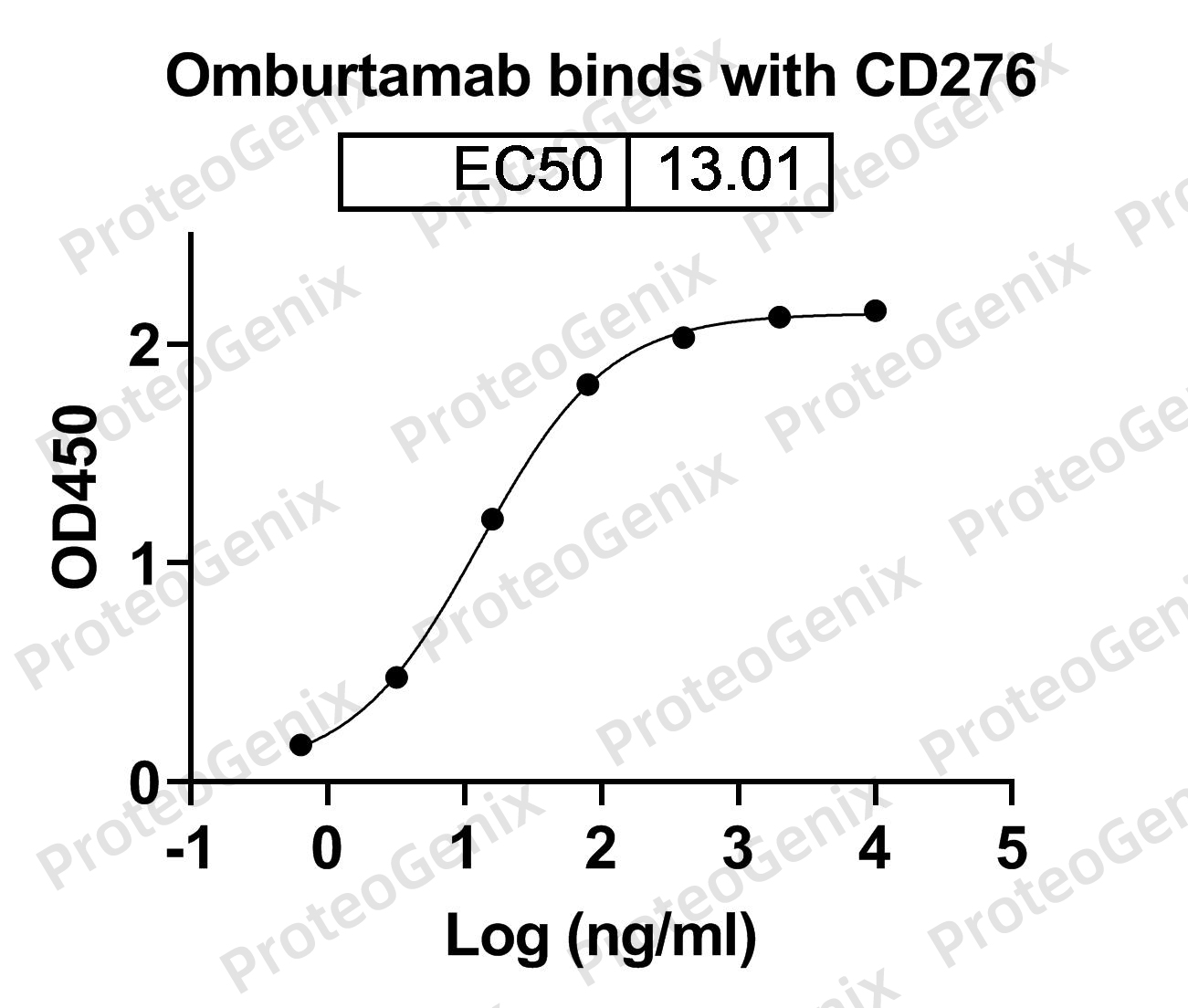
Immobilized CD276 Recombinant Protein (cat. No.PX-P4125) at 0.5µg/mL (100µL/well) can bind Omburtamab Biosimilar - Anti-CD276; B7-H3; B7RP-2 mAb - Research Grade (cat. No.PX-TA1532) in indirect ELISA with Goat Anti-Human IgG secondary antibody coupled with HRP measured by OD450 giving an EC50 at 13.01M.
Related products



Send us a message from the form below
Reviews
There are no reviews yet.