Cart (0 Items)
Your cart is currently empty.
View Products



| Size | 100ug, 1MG |
|---|---|
| Isotype | IgG1, kappa |
| Brand | ProteoGenix |
| Product type | Primary Antibodies |
| Clonality | Monoclonal Antibody |
| Expression system | Mammalian cells |
| Applications | Elisa, WB |
| Product name | Osocimab Biosimilar - Anti-F11 mAb - Research Grade |
|---|---|
| Source | CAS 2056878-75-0 |
| Species | Homo sapiens |
| Purity | >85% |
| Buffer | PBS buffer PH7.5 |
| Delivery condition | Blue ice (+4°C) |
| Delivery Time | 3-5 days if in stock; 3-5 weeks if production needed |
| Storage condition | store at -80°C |
| Brand | ProteoGenix |
| Aliases /Synonyms | Osocimab,BAY 1213790,F11,anti-F11 |
| Reference | PX-TA1534 |
| Note | For research use only. Not suitable for clinical or therapeutic use. |
| Isotype | IgG1, kappa |
| Clonality | Monoclonal Antibody |
Osocimab Biosimilar, also known as Anti-F11 mAb, is a monoclonal antibody that is currently being developed as a biosimilar to the original drug Osocimab. This biosimilar is designed to target and inhibit the activity of Factor 11 (F11), a protein involved in the blood coagulation process. In this article, we will delve into the structure, activity, and potential applications of Osocimab Biosimilar as a research grade antibody.
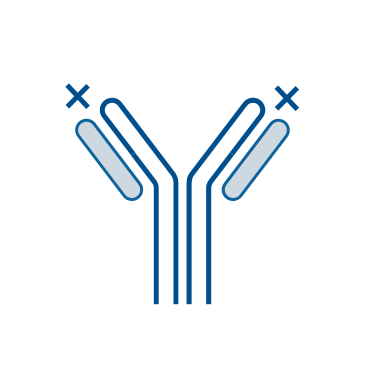
Osocimab Biosimilar is a recombinant humanized monoclonal antibody that is produced through genetic engineering techniques. It is composed of two identical heavy chains and two identical light chains, each containing a variable region and a constant region. The variable region of the antibody is responsible for binding to its target, F11, while the constant region plays a role in the antibody’s effector functions.
The amino acid sequence of Osocimab Biosimilar is highly similar to that of the original drug, with minor differences in the constant region to ensure its biosimilarity. This similarity in structure allows for the biosimilar to have similar binding and functional properties as the original drug, making it a potential alternative for therapeutic use.
Osocimab Biosimilar is a potent inhibitor of F11, a protein involved in the intrinsic pathway of blood coagulation. F11 is activated in response to tissue injury and plays a crucial role in the formation of blood clots. However, excessive activation of F11 can lead to pathological blood clotting, which can result in serious conditions such as thrombosis and stroke.
By binding to F11, Osocimab Biosimilar prevents its activation and inhibits the formation of blood clots. This activity has been demonstrated in preclinical studies, where the biosimilar showed a significant reduction in thrombus formation compared to controls. This suggests that Osocimab Biosimilar has the potential to be an effective therapeutic agent for conditions associated with abnormal blood clotting.
As a research grade antibody, Osocimab Biosimilar has the potential to be used in various applications in the field of coagulation research. Its ability to specifically target and inhibit F11 makes it a valuable tool for studying the role of this protein in blood clotting and related disorders.
Furthermore, Osocimab Biosimilar can also be used in the development of diagnostic assays for F11-related conditions. By detecting the presence of F11 in patient samples, the biosimilar can aid in the early diagnosis and monitoring of diseases such as thrombosis and stroke.
In addition, Osocimab Biosimilar may also have potential therapeutic applications in the treatment of F11-related disorders. With its ability to inhibit F11, the biosimilar could potentially be used as a therapeutic agent for conditions such as deep vein thrombosis and pulmonary embolism.
Osocimab Biosimilar, also known as Anti-F11 mAb, is a recombinant humanized monoclonal antibody that is being developed as a biosimilar to the original drug Osocimab. Its structure, activity, and potential applications make it a promising research grade antibody in the field of coagulation research. With its ability to specifically target and inhibit F11, Osocimab Biosimilar has the potential to contribute to the development of new treatments and diagnostic tools for F11-related disorders.
Related products

Send us a message from the form below
Reviews
There are no reviews yet.