Cart (0 Items)
Your cart is currently empty.
View Products
Case report
Download the complete case report Contact our Experts
Client
Australian start-up
Sector
Therapeutics
Target disease
Breast Cancer
Timeline
3 weeks
Key processes
ProteoGenix was trusted to develop a panel of high-quality antibodies for an Australian start-up developing a breakthrough CAR-T cell therapy targeting breast cancer. The client faced a critical challenge: identifying the optimal antibody sequence capable of recognizing their tumor-associated target with both high affinity and specificity. To maximize their chances of success in this high-stakes therapeutic program, the strategy prioritized generating a large, diverse set of validated antibody candidates rather than a handful of options. This approach would provide the client with multiple shots on goal for their clinical development pipeline.
1
Generate a high number of qualitative antibodies
2
Balancing enriching for high-affinity binders while preserving library diversity
For this project, phage display technology emerged as the ideal solution. Unlike traditional hybridoma or animal immunization approaches that require months, phage display enables the rapid screening of billions of antibody variants in just weeks—a critical advantage when speed-to-clinic matters. The technology’s ability to interrogate massive libraries in vitro means we could cast a wide net to capture rare, high-quality binders while maintaining strict control over selection pressure and specificity requirements.
We selected our proprietary LiAb-SFMAX™ library—one of the largest fully human scFv libraries in the industry, boasting an exceptional diversity of 5.37×10¹⁰ unique clones. This massive sequence space is key to the project’s performance. With billions of distinct antibody variants pre-built and ready to screen, we could simultaneously explore multiple epitopes, binding modes, and antibody frameworks in a single campaign.
This dramatically increased the odds of capturing not just one hit, but dozens of distinct, therapeutically relevant candidates. For a CAR-T program where epitope choice and binding kinetics can make or break clinical success, this diversity translates into a de-risked development path.
Panning of our proprietary LiAb-SFMAXTM library (diversity of 5.37×10¹⁰ different clones, scFv)
Single phage binders ELISA screening (480 phage-binders)
Sequencing of the ones binding specifically to the antigen resulting in 130 unique sequences
Validation by Monoclonal Phage ELISA of the 130 clones
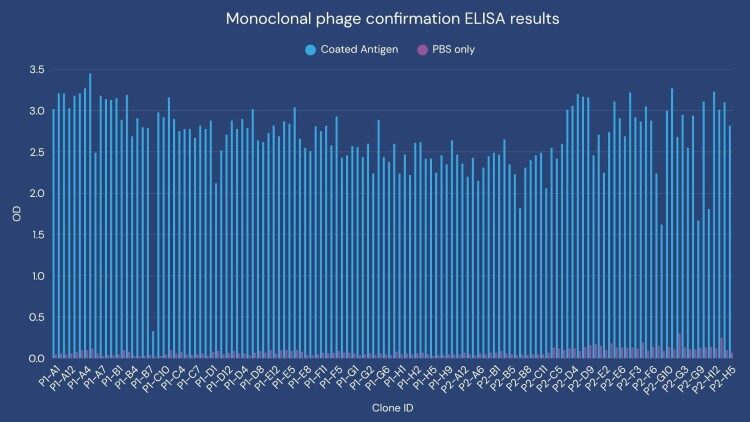
Initial screening of 480 randomly selected phage-display binders identified 453 clones demonstrating specific binding to the target antigen relative to negative controls. Sequencing analysis of these 453 clones revealed 130 distinct, unique antibody sequences. To ensure robust clone quality, all 130 unique sequences underwent re-validation in ELISA. It is a critical confirmation step necessary as phage-display derived clones can occasionally exhibit non-specific binding, potentially compromising result reliability. In this project, all 130 sequences successfully demonstrated specific binding to the antigen, providing the client with a high-confidence panel of validated antibody candidates for CAR-T therapy development.
ProteoGenix screened 480 phage-display binders and identified 130 distinct, fully validated antibody sequences for an Australian start-up in just 3 weeks.
All 130 unique candidates successfully passed re-validation by monoclonal phage ELISA, ensuring a high-confidence, diverse antibody panel.
This robust dataset maximizes the client’s chances of identifying an optimal sequence for clinical-stage CAR-T cell therapy development in breast cancer.
Want to know more about this project?
Download the full case report to read the protocols, detailed results and more.