Cart (0 Items)
Your cart is currently empty.
View Products
Let’s talk about your project Download the full case report
Client
Californian University
Sector
Research
Target
PD-1 for non-small cell lung cancer
Timeline
3 weeks
Key processes
A Californian university working in immuno-oncology partnered with ProteoGenix to identify VHH binders against PD-1, a key immune checkpoint target in non-small cell lung cancer research.
Using the customer-provided PD-1 antigen, ProteoGenix screened a high-diversity naïve camelid VHH library to identify early-stage binder candidates. The initial guarantee was at least 3 binder sequences, with the goal of generating a broader panel for downstream evaluation.
ProteoGenix applied a stepwise phage display strategy combining biopanning, ELISA screening, confirmation testing, and sequencing to maximize binder diversity and rapidly deliver validated VHH candidates.
Monitoring enrichment while preserving phage diversity
Selecting individual binders with strong antigen-specific signals and low background
Confirming clone specificity before sequence delivery
ProteoGenix implemented a stepwise VHH phage display workflow, from antigen biopanning to ELISA-based binder confirmation and sequence delivery.
ProteoGenix performed a phage display campaign using a naïve camelid VHH library with a diversity of 1.51 × 10¹⁰ different clones. The customer-provided PD-1 antigen was used as the target for biopanning.
Three rounds of biopanning were carried out, showing significant enrichment of antigen-binding phages. Polyclonal phage ELISA confirmed strong specific binding with very low background, supporting the selection of round 1 for monoclonal screening in order to preserve binder diversity.
A total of 96 individual clones were screened by monoclonal phage ELISA. Thirty clones were clearly positive and selected for sequencing, resulting in 14 unique VHH sequences.
All 14 unique clones were re-tested by confirmation ELISA to verify specificity. The results confirmed strong and specific binding to PD-1, and all 14 sequences were delivered to the customer for further evaluation.
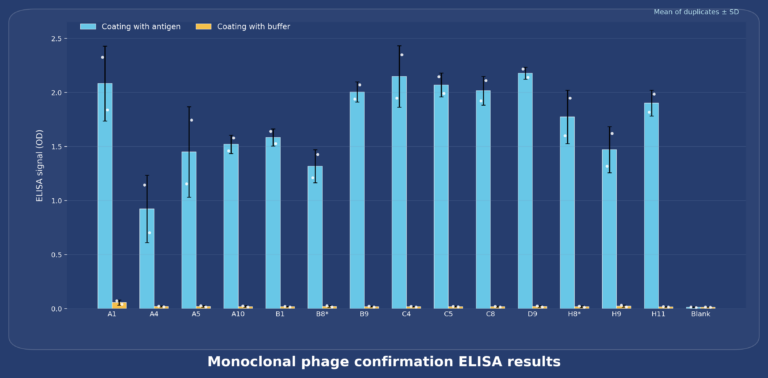
The campaign successfully identified 14 unique VHH sequences binding to PD-1. All 14 clones were confirmed by ELISA to specifically and strongly bind the antigen, with very low background on the buffer-coated negative control (see figure).
Although the initial project guarantee was at least 3 sequences, ProteoGenix delivered 14 unique binder sequences to the customer.
The customer then expressed the 14 antibodies as recombinant VHHs and tested them against cells overexpressing PD-1 at their surface. Ten of the 14 VHHs showed clear binding to the target cells compared with control cells. Among these, 5 VHHs also showed blocking activity.
ProteoGenix helped the customer rapidly build a strong PD-1-targeting VHH candidate panel for non-small cell lung cancer research, delivering 14 unique binder sequences instead of the guaranteed minimum of 3.
The campaign gave the customer more options for downstream evaluation, with 10 recombinant VHHs confirmed to bind PD-1-expressing cells and 5 showing blocking activity.
By delivering a larger and functionally relevant candidate pool in only 3 weeks, ProteoGenix helped accelerate and de-risk the customer’s early-stage antibody discovery workflow.
Let’s talk about your project Download the full case report
The 14 antibodies were expressed as recombinant VHHs and tested against cells overexpressing PD-1 at their surface. Ten of them bound well to the cells with a clear shift compared to control cells, of which 5 even had blocking activity. Overall, we have many more clones than expected and are quite happy with them.