Cart (0 Items)
Your cart is currently empty.
View Products
Case report
Download the complete case report Contact our Experts
Client
American pharmaceutical company
Sector
Therapeutics
Target disease
Melanoma
Timeline
3 weeks
Key processes
An American pharmaceutical company sought to develop a next-generation CAR-T therapy for melanoma by targeting a disease-specific peptide-HLA (pHLA) complex. The challenge? Achieving perfect selectivity. The antibody needed to recognize the target pHLA—a specific peptide presented by an HLA molecule on tumor cells—while completely avoiding cross-reactivity with the same HLA molecule presenting irrelevant or self-peptides. This level of discrimination is notoriously difficult: a single amino acid difference in the peptide can determine whether a cell is cancerous or healthy, and any off-target binding could trigger life-threatening autoimmunity in patients.
With specificity validated, the winning antibody would be engineered into a CAR-T construct, arming T cells to hunt down and destroy only melanoma cells displaying this molecular signature.
1
Targeting the relevant pHLA specifically
2
Achieving high affinity without causing interaction with the irrelevant counter-pHLA
Targeting pHLA complexes is among the most technically demanding challenges in antibody discovery. The binding interface is subtle, and traditional immunization methods struggle to generate the required specificity. Phage display, by contrast, enables direct in vitro selection against both the desired target and unwanted counter-targets simultaneously—a critical capability for negative selection. Moreover, the technology’s rapid three-week timeline allowed the client to quickly test multiple candidates and accelerate their path to preclinical validation, a decisive advantage in the competitive CAR-T landscape.
To tackle this high-stakes target, we deployed three of our proprietary immune libraries in parallel:
Why three libraries for this project? pHLA-targeting antibodies must distinguish between nearly identical molecular surfaces—essentially reading a single peptide “barcode” on the HLA platform. By screening three distinct immune repertoires (totaling >2×10¹¹ unique clones), we maximized our chances of finding rare binders with the extraordinary selectivity required.
Relevant antigen pHLA and antigen HLA loaded with irrelevant peptide (counter pHLA)
Phage display rounds with our 3 proprietary immune libraries:
Screening of the binders by ELISA against relevant and irrelevant pHLA
Re-screening of best candidates to ensure specific binding
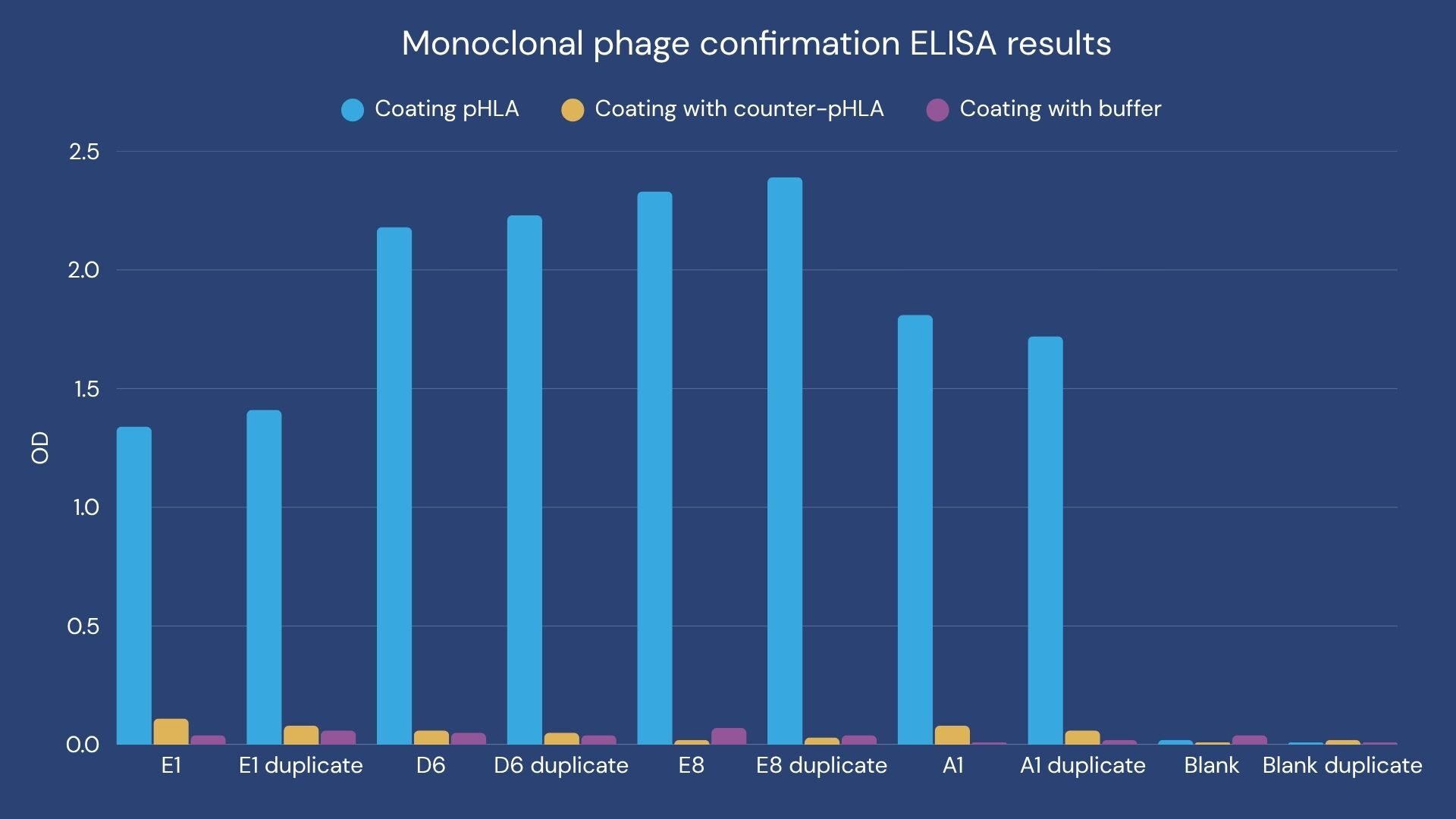
Our screening campaign identified 17 clones that demonstrated clear positivity and specificity to the target pHLA. Sequencing analysis of these clones yielded 4 distinct, unique antibody sequences. Comprehensive data validation confirmed that all 4 clones specifically and strongly bound to the pHLA, leading the client to order the complete sequence set. Following additional characterization and testing, the client selected the best-performing candidate and successfully validated the resulting CAR-T therapy in preclinical assays, confirming its therapeutic potential.
ProteoGenix successfully identified 4 unique antibody candidates for an American pharmaceutical company by screening 3 proprietary phage display libraries in just 3 weeks.
All candidates demonstrated highly specific binding to the melanoma-associated pHLA target while avoiding cross-reactivity with similar irrelevant molecules.
The best-performing candidate was then engineered into a CAR-T cell therapy, successfully validated in preclinical assays.
Want to know more about this project?
Download the full case report to read the protocols, detailed results and more.