
Cart (0 Items)
Your cart is currently empty.
View Products Protein production
 Thomas Meyer
XtenCHO™ Race is a mammalian cell-based transient host developed from a highly productive Chinese Hamster Ovary (CHO) cell line. The original host has been extensively engineered to maximize protein production and processing, resulting in superior secretion and folding, delayed apoptosis, and efficient protein glycosylation.
Together with an optimal growth medium (chemically defined and animal-free), efficient one-step transfection reagent, and high expression vector, XtenCHO™ Race achieves up to 2x up to 2x higher yields compared to market leader, and maintains consistent expression levels for more than 14 days. Given its optimal protein folding and post-translational modifications, XtenCHO™ Race is ideal for the production of small to medium-scale quantities of monoclonal antibodies and other complex and soluble proteins (e.g., enzymes, soluble receptors, among others).
This transient expression system was designed to cater to three major applications:
Developing a new drug is a complex process, taking up to a decade or more to bring an early concept to the clinic and entailing investments in the order of the hundreds of thousands. Despite the industry’s best efforts, the majority of early candidates (>90%) never make it into clinical trials. Unexpected developability or scalability problems are often cited as the main culprits of this high failure rate.
Experts have identified several strategies to overcome current drug development constraints. The most important of these entail early screening and bioanalysis of drug candidates in transient systems. But what makes a host optimal for studying the developability profile of a new drug?
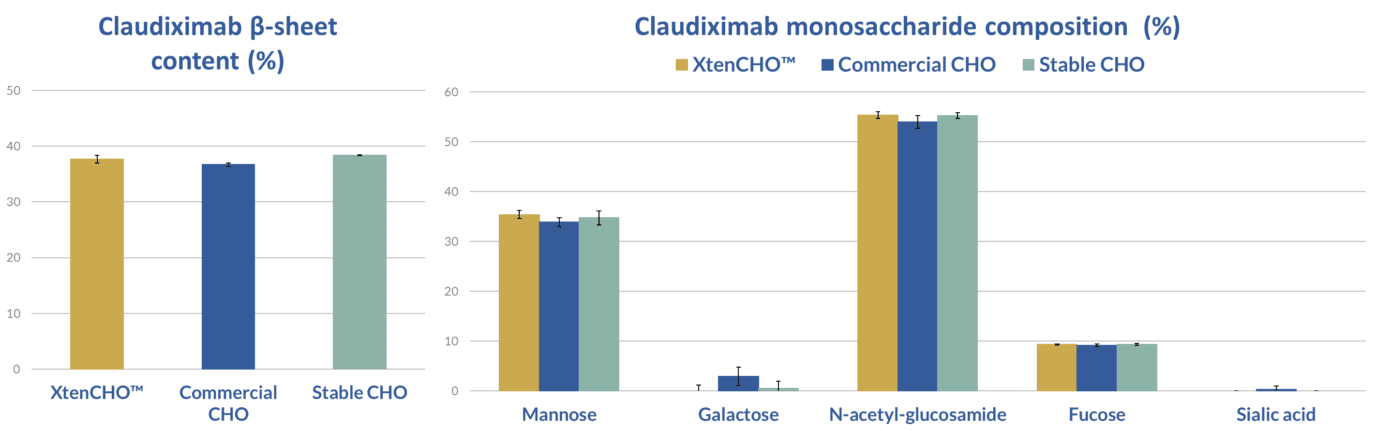
XtenCHO™ Race was designed to answer these needs. Endowed with smart protocols for easy integration into existing workflows, this new system can produce monoclonal antibodies that are indistinguishable from those produced in stable high-quality systems. This vital feature of the system allows the detection of developability issues early during the process (e.g., high aggregation, low stability at high temperatures, among others) and the quick transition from transient to stable biopharmaceutical-grade expression.
Often, promising proteins or mAbs require fine-tuning to fit specific applications. For instance, mAbs obtained from non-human hosts require humanization to reduce immunogenicity and increase therapeutic effectiveness. Similarly, the process of fine-tuning affinity in mAbs and enzymes is often vital to ensure these biologicals have (i) sufficient affinity towards the desired target and (ii) low affinity towards non-related but structurally similar targets.
These efforts of protein engineering span multiple fields, from therapeutic protein development to bioproduction, diagnostics, or even biosensing applications. Independently of the final application, protein engineering requires:
Although in silico drug discovery and engineering has advanced significantly, it can only assist the process up to a certain point. Once candidates with potentially enhanced properties are identified and narrowed down to manageable numbers, protein screening becomes the vital next step. In this context, the use of a fast, reproducible, and optimized transient system can be an advantage and mitigate the risk of developability issues down the line.
At ProteoGenix, the efficiency of our protein engineering platform rests on the rapid production of protein variants in XtenCHO™ Race transient systems. The rapidity and reliability of the platform makes early proof-of-concept studies feasible which, in turn, maximizes the success of protein engineering processes.
Monoclonal antibodies, enzymes, and other proteins are indispensable tools in our current molecular biology toolbox. Most mAbs are used in multiple immunoassays that aim at detecting, monitoring, and even quantifying proteins in vitro or in vivo. These assays are typically employed in research (medical, basic, environmental, among others) or diagnostics:
Presently, mAbs used in immunoassays for research applications are primarily produced in hybridoma cell lines. These lines are stored in international or local cell banks and can be purchased or exchanged between researchers from different laboratories.
However, producing mAbs for these assays in hybridomas instead of recombinant systems comes with a downside:
These risks can be mitigated by the use of highly productive and easy-to-optimize systems like XtenCHO™ Race. With smart protocols and reduced hands-on time, the new transient system was designed to be easily integrated into existing immunoassay workflows, making the transition from native hybridoma to recombinant production stress-free.
Join our email list to receive exclusive content featuring the most interesting industry and research news, biologics development tips pieced together by experts, res, company news, and exclusive limited-offers. Join a community of 80,000 subscribers and save up to 30% on your first order.